Manufacturing companies face increasingly complex challenges in managing production, raw material inventory, procurement, and the shipment of finished goods. As production volumes increase, the use of spreadsheets or disparate systems often leads to delays in information flow, inventory errors, and difficulties in accurately tracking production costs.
To address these challenges, many companies are turning to SAP Business One for Manufacturing as an ERP solution capable of integrating all business processes into a single platform.
With SAP Business One, manufacturing companies can manage production in a more structured way, monitor inventory in real time, and generate more accurate business reports to support decision-making.
Challenges Often Faced by Manufacturing Companies
Many manufacturing companies experience problems such as:
-
Inaccurate raw material inventory
-
Excess or insufficient inventory
-
Difficulty monitoring the production process
-
Production costs are not properly measured
-
Delayed operational reports
-
Transaction recording errors
-
Lack of visibility across departments
If these issues persist, production efficiency will decline and the company’s profits may be affected.
What Is SAP Business One?
SAP Business One is an ERP solution designed for small and medium-sized businesses as well as growing companies.
This system helps integrate:
-
Finance
-
Sales
-
Purchasing
-
Inventory
-
Production
-
CRM
-
Business Reporting
All data is stored in a single database so that every department works with the same information.
Why Is SAP Business One Suitable for Manufacturing?
1. Integrated Production Management
One of the key advantages of SAP Business One for manufacturing is its ability to manage production processes within a single system.
Companies can:
-
Create Production Orders
-
Monitor production status
-
Manage the Bill of Materials (BoM)
-
Control the use of raw materials
This helps improve efficiency and reduce waste.
2. Controlling Raw Material and Finished Goods Inventory
SAP Business One enables companies to monitor inventory in real time.
Benefits:
-
Knowing the availability of raw materials
-
Reducing the risk of stockouts
-
Avoiding overstock
-
Monitoring finished goods more accurately
3. Material Requirements Planning (MRP—Manufacturing Resource Planning)
The Material Requirements Planning feature helps companies calculate raw material requirements based on production plans.
With MRP, companies can plan purchases and production more efficiently.
4. Production and Financial Integration
Every production activity is directly linked to financial data.
Benefits:
-
More accurate production costs
-
Product margins can be calculated more effectively
-
Financial reports are available faster
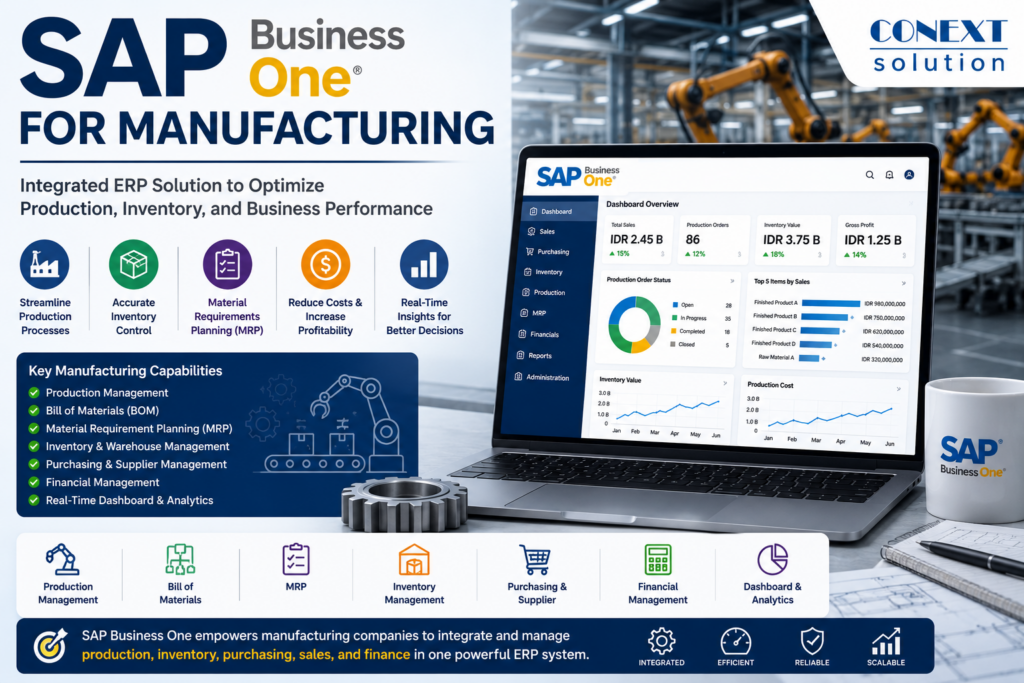
5. Real-Time Dashboards and Reports
Management can monitor:
-
Production performance
-
Raw material usage
-
Inventory value
-
Production costs
-
Best-selling products
-
Profitability
With real-time data, business decisions can be made more quickly.
Benefits of SAP Business One for Manufacturing Companies
Improving Production Efficiency
Production processes become more structured and easier to monitor.
Reducing Data Errors
All information is stored in a single integrated system.
Improving Inventory Accuracy
Companies can track real-time inventory levels.
Controlling Production Costs
Raw material and production costs can be monitored more effectively.
Supporting Business Growth
SAP Business One can keep pace with business growth and increased production capacity.
Key SAP Business One Features for Manufacturing
| Features | Function |
|---|---|
| Production Management | Manage the production process |
| Bill of Materials | Manage product structure |
| MRP | Material Requirements Planning |
| Inventory Management | Managing Stock |
| Purchasing | Managing Raw Material Purchases |
| Financial Management | Managing costs and finances |
| Analytics & Reporting | Providing business insights |
When Do Manufacturing Companies Need SAP Business One?
Companies typically begin to need an ERP system when:
-
Production volumes increase
-
Inventory levels are often inaccurate
-
They have multiple warehouses
-
They use many separate applications
-
They need faster reports
-
Want to improve operational efficiency
If some of these conditions apply, implementing SAP Business One can be a strategic step to support business growth.
SAP Business One vs. Manual Systems
| Aspect | Manual System | SAP Business One |
|---|---|---|
| Data Accuracy | Low | High |
| Production Monitoring | Limited | Real-Time |
| Inventory Control | Limited | Integrated |
| Reporting | Slow | Automated |
| Scalability | Limited | High |
SEE ALSO: Odoo CRM: Features, Benefits, and How to Boost Your Company’s Sales
SAP Business One for manufacturing is an ERP solution that helps companies manage production, inventory, purchasing, and finances more efficiently.
With data integration capabilities, real-time production monitoring, Material Requirements Planning (MRP), and comprehensive analytical dashboards, SAP Business One can help manufacturing companies increase productivity while supporting long-term business growth.
For manufacturing companies looking to improve operational control and reduce business process errors, SAP Business One is an ERP solution worth considering.