Distribution companies face increasingly complex challenges in managing inventory, shipping, purchasing, and sales. As the number of customers grows and transaction volumes increase, the use of spreadsheets or non-integrated systems often leads to delays in information, data errors, and decreased productivity.
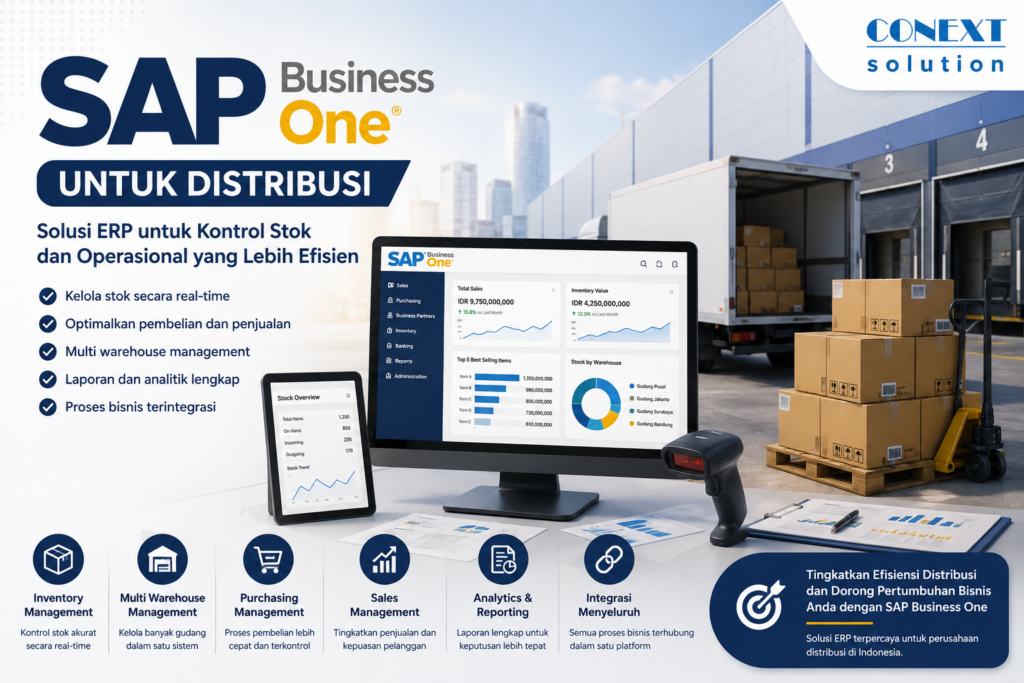
To address these challenges, many companies are turning to SAP Business One for Distribution as an ERP solution capable of integrating all business processes into a single platform.
With SAP Business One, distribution companies can gain real-time inventory visibility, streamline operational processes, and improve the quality of decision-making.
Common Challenges Faced by Distribution Companies
Many distributors face issues such as:
- Inaccurate inventory
- Overstocking and stockouts
- Slow purchasing processes
- Difficulty monitoring multiple warehouses
- Non-real-time reports
- Transaction recording errors
- Difficulty tracking customer history
If these issues persist, business growth will be hindered and operating costs will continue to rise.
What Is SAP Business One?
SAP Business One is an ERP solution specifically designed for small and medium-sized enterprises (SMEs) and growing companies.
This system helps integrate:
- Finance
- Sales
- Purchasing
- Inventory
- Production
- CRM
- Business Reporting
All data is stored in a single database so that every department works with the same information.
SEE ALSO: SAP Business One vs. Odoo: Which ERP Is Better for Your Business?
Why Is SAP Business One a Good Fit for Distribution Companies?
1. Real-Time Inventory Control
One of the biggest challenges for distributors is maintaining product availability.
SAP Business One enables companies to:
- Monitor inventory in real time
- Track the location of goods
- View available inventory and inventory in transit
- Reduce the risk of stockouts
This helps improve inventory accuracy and customer satisfaction.
2. Multi-Warehouse Management
Many distributors have more than one warehouse.
SAP Business One supports:
- Multi-warehouse management
- Stock transfers between warehouses
- Inventory monitoring by location
- Tracking of goods movements
All data can be accessed through a single centralized system.
3. Purchasing Process Automation
The system can help companies determine when to reorder based on:
- Minimum stock level
- Sales history
- Demand forecasts
This automation helps maintain product availability without excessively increasing storage costs.
4. Sales and Inventory Integration
Every sales transaction will directly affect inventory data.
Benefits:
- Data is always accurate
- No duplicate entries
- Faster processes
- Reduced risk of human error
5. Real-Time Reporting and Dashboards
Management needs fast and accurate data.
SAP Business One provides a dashboard that displays:
- Inventory levels
- Sales performance
- Product margins
- Best-selling products
- Inventory turnover
With real-time data, business decisions can be made faster.
Benefits of SAP Business One for Distributors
Improved Operational Efficiency
Business processes become more structured and automated.
Reducing Data Errors
All information is stored in a single integrated system.
Improves Inventory Accuracy
Companies can track real-time inventory levels.
Speeding Up Shipments
Information on product availability can be accessed instantly.
Supporting Business Growth
SAP Business One can keep pace with business growth and increased transaction volumes.
Key SAP Business One Features for Distributors
Inventory Management
Manage inventory in real time.
Purchasing Management
Control the purchasing process and suppliers.
Sales Management
Manage quotes, sales orders, and invoices.
CRM
Manage customer relationships more effectively.
Financial Management
Automatically integrate all financial transactions.
Analytics and Reporting
Providing data-driven business insights.
When Do Distributors Need SAP Business One?
Distribution companies typically begin to need an ERP system when:
- The number of transactions increases dramatically
- They have more than one warehouse
- They have difficulty controlling inventory
- They use many separate applications
- They need faster reports
- Want to improve operational efficiency
If any of these conditions apply, implementing SAP Business One can be a strategic step to support business growth.
SAP Business One vs. Manual Systems
| Aspect | Manual System | SAP Business One |
|---|---|---|
| Data Accuracy | Low | High |
| Inventory Monitoring | Limited | Real-Time |
| Department Integration | None | Integrated |
| Reporting | Slow | Automated |
| Scalability | Limited | High |
SEE ALSO: ODOO ERP IMPLEMENTATION: STAGES, BENEFITS, AND SUCCESS FACTORS
SAP Business One for distribution is an ERP solution that helps companies manage inventory, purchasing, sales, and operations more efficiently.
With data integration capabilities, real-time inventory monitoring, and comprehensive analytical dashboards, SAP Business One can help distributors boost productivity while supporting long-term business growth.
For distribution companies looking to improve operational control and reduce business process errors, SAP Business One is an ERP solution worth considering.
FAQ
What is SAP Business One for Distribution?
SAP Business One for distribution is an ERP solution that helps distribution companies manage inventory, purchasing, sales, and operations in an integrated manner.
Does SAP Business One support multi-warehouse management?
Yes. SAP Business One features multi-warehouse management capabilities to manage multiple warehouses within a single system.
What are the benefits of SAP Business One for distributors?
The benefits include real-time inventory control, business process automation, faster reporting, and improved operational efficiency.
Is SAP Business One suitable for medium-sized distribution companies?
Yes. SAP Business One is designed to support the needs of small to medium-sized growing companies.
Why do distributors need an ERP system?
An ERP system helps integrate all business processes so that companies can operate more efficiently and make decisions based on accurate data.