What Is ERP?
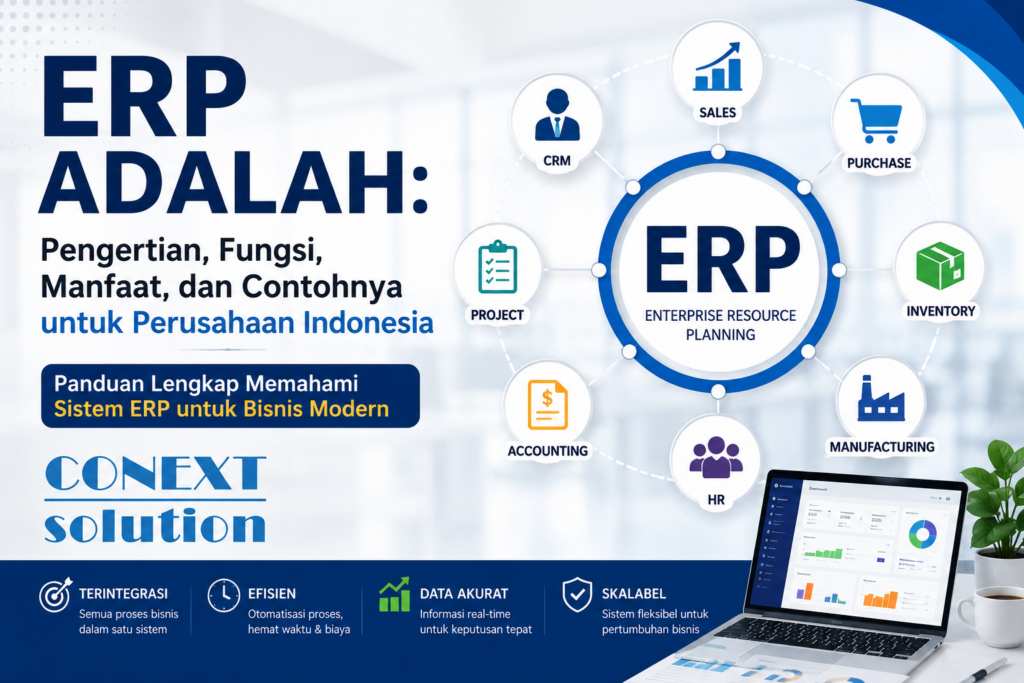
ERP stands for Enterprise Resource Planning, which is a software system used to integrate various business processes into a single centralized platform. With ERP, companies can manage operational activities such as finance, sales, purchasing, inventory, production, human resources (HR), and project management more efficiently.
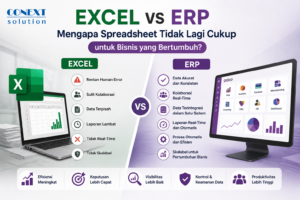
In today’s digital age, companies can no longer rely on spreadsheets or standalone applications. As the volume of transactions increases and operations become more complex, a system is needed that can connect all departments through a single, shared data source. This is the primary role of ERP.
ERP helps companies gain full visibility into business activities so that decisions can be made based on accurate, real-time data.
Why Is ERP Important for Modern Companies?
Many companies face the same problem as their business begins to grow:
- Data is scattered across multiple systems
- Information across departments is out of sync
- Manual processes are time-consuming
- Data entry errors occur frequently
- Reports are difficult to generate quickly
As a result, productivity declines and management struggles to get a comprehensive overview of the business.
ERP serves as a solution to integrate all business processes into a single, interconnected system.
How Does ERP Work?
ERP operates on the concept of a centralized database.
Each department uses different modules according to its needs, but all modules share the same data.
For example:
The Sales team creates a Sales Order.
That data can automatically be used by:
- the Warehouse Team to prepare goods
- The Purchasing Team to make purchases if stock is low
- The Finance Team to create invoices
- Management to view sales reports
There is no need for re-entry, which prevents data duplication.
This is why ERP can significantly improve operational efficiency.
READ ALSO: What Is Odoo ERP? A Comprehensive Guide for Indonesian Companies in 2026
The Role of ERP in a Company
1. Integrating All Business Processes
ERP connects various departments so that information can flow automatically without any obstacles.
2. Reducing Manual Work
Many activities that were previously done manually can be automated.
For example:
- Invoice generation
- Purchase approvals
- Data reconciliation
- Financial reporting
3. Improving Data Accuracy
Since all data is in a single system, the risk of errors due to duplicate entries can be reduced.
4. Providing Real-Time Reports
Management can monitor business conditions at any time through dashboards and reports that are constantly updated.
5. Supporting Decision-Making
Accurate data helps companies make faster and more precise decisions.
Benefits of ERP for Companies
Operational Efficiency
ERP helps reduce unproductive administrative tasks.
Cost Savings
Automating business processes can reduce operating costs in the long term.
Increased Productivity
Employees can focus on strategic work rather than repetitive administrative tasks.
Data Transparency
All departments use the same information, leading to better coordination.
Business Scalability
ERP makes it easier for companies to grow without having to replace their systems every time the business expands.
Key Modules in ERP
Finance and Accounting
Manages:
- General Ledger
- Accounts Receivable
- Accounts Payable
- Cash flow
- Financial reports
Sales Management
Manage:
- Quotations
- Sales orders
- Sales Pipeline
- Forecasting
Customer Relationship Management (CRM)
Helps companies manage customer relationships and sales leads.
Inventory Management
Controls:
- Inventory
- Warehouse transfers
- Inventory counts
- Reorder point
Purchasing
Manage the procurement process and relationships with suppliers.
Manufacturing
Used for:
- Bill of Materials (BOM)
- Production Order
- Work Center
- Quality Control
Human Resources (HR)
Manage:
- Employee data
- Payroll
- Attendance
- Time Off
- Recruitment
Types of ERP
On-Premise ERP
The system is installed on the company’s own servers.
Advantages:
- Full control over data
- High level of customization
Disadvantages:
- Higher initial investment
- Requires an in-house IT team
Cloud ERP
The system is accessed via the internet.
Advantages:
- Faster implementation
- Lower upfront costs
- Easy to access from anywhere
Disadvantages:
- Depends on an internet connection
Currently, most new companies prefer Cloud ERP.
Examples of Popular ERP Software
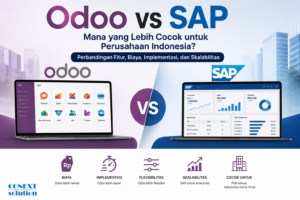
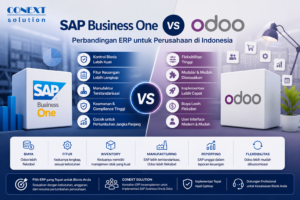
Odoo ERP
Odoo is one of the fastest-growing ERP platforms due to its flexibility and modularity.
Available modules include:
- CRM
- Accounting
- Inventory
- Manufacturing
- HR
- Website
- E-Commerce
Odoo is suitable for small, medium, and enterprise-sized companies.
SAP ERP
SAP is known as an enterprise ERP solution widely used by large companies around the world.
Oracle NetSuite
A popular cloud ERP solution among global companies.
Microsoft Dynamics 365
Cloud-based ERP and CRM from Microsoft.
Who Needs ERP?
ERP isn’t just for large companies.
Various types of businesses can benefit from ERP, such as:
Manufacturing
Managing production, raw materials, and product quality.
Distribution
Managing inventory and the distribution of goods.
Retail
Integrating physical and online stores.
Logistics
Optimizing shipping and fleet management.
Construction
Manage projects and budgets more effectively.
Signs That Your Company Needs an ERP
Here are some signs that your company needs an ERP system:
- Data is still scattered across multiple spreadsheets
- Reports take a long time to generate
- Inventory errors occur frequently
- The approval process is slow
- It’s difficult to monitor business performance in real time
- The number of transactions continues to increase
If some of these conditions apply, implementing an ERP system can be a strategic move.
Challenges of ERP Implementation
Although it offers many benefits, ERP implementation requires careful planning.
Some common challenges include:
- Data migration
- Business Process Changes
- User Adoption
- Integration of legacy systems
- Training needs
That is why many companies choose to work with experienced ERP consultants.
The Future of ERP in Indonesia
The accelerating pace of digital transformation is driving ERP adoption across various industrial sectors.
Companies now need systems that not only record transactions but also provide real-time business insights.
The combination of ERP with technologies such as Business Intelligence (BI), Artificial Intelligence (AI), and Automation is expected to become the new standard in modern business management.
ERP is a system that helps companies integrate all business processes into a single, centralized platform. With ERP, companies can improve operational efficiency, reduce data errors, accelerate decision-making, and support long-term business growth.
Manufacturing, distribution, retail, logistics, and service companies alike can leverage ERP to tackle increasingly complex business challenges. Proper ERP implementation is not just a technology investment, but also a strategic investment in the company’s future.