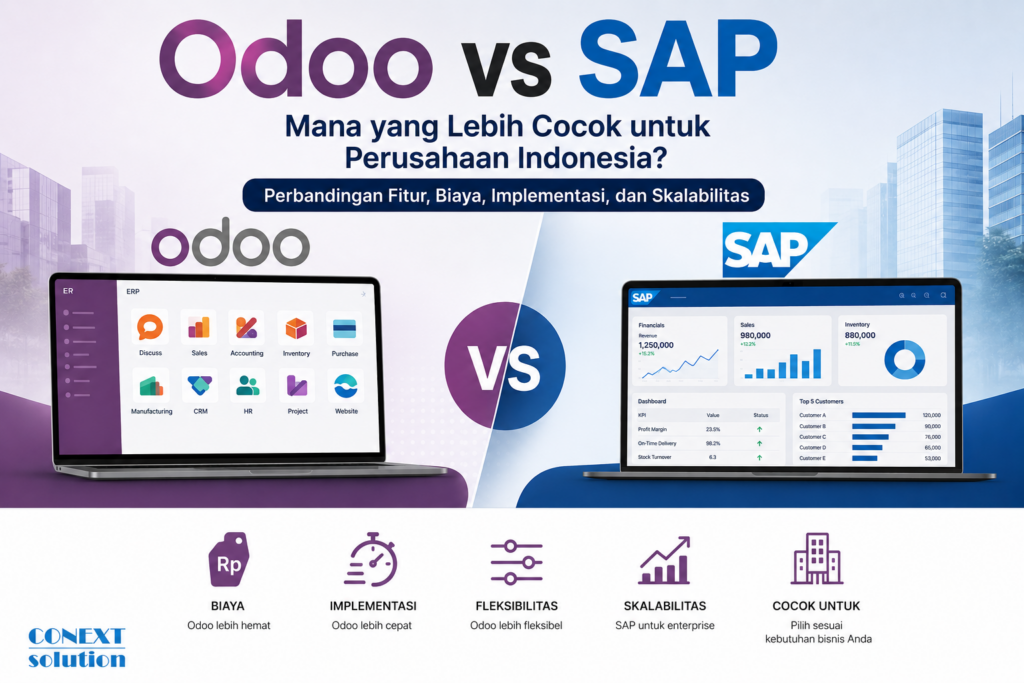
Odoo vs. SAP: Which Is Better Suited for Indonesian Companies?
Introduction
When companies begin considering the implementation of Enterprise Resource Planning (ERP), two names that often come up are Odoo and SAP. Both are ERP solutions used by thousands of companies worldwide to manage business processes in an integrated manner.
However, many business owners and managers ask:
Which is better, Odoo or SAP?
The answer isn’t as simple as choosing the one with more features. Each platform has different strengths, target users, and implementation approaches.
In this article, we’ll compare Odoo and SAP across various key aspects, such as cost, flexibility, ease of use, implementation, and suitability for companies in Indonesia.
Getting to Know Odoo ERP
Odoo is a modern ERP platform that uses a modular approach. Companies can select modules based on their needs and add others as their business grows.
Some popular Odoo modules include:
- CRM
- Sales
- Accounting
- Inventory
- Manufacturing
- Purchasing
- Human Resources
- Project Management
- Website and E-Commerce
Odoo’s main strengths lie in its flexibility and relatively more affordable implementation costs compared to traditional enterprise ERP systems.
Understanding SAP ERP
SAP is one of the world’s largest ERP providers and is used by many large companies and multinational corporations.
Commonly used SAP products include:
- SAP S/4HANA
- SAP Business One
- SAP Business ByDesign
SAP is known for its ability to handle complex business processes and extremely high transaction volumes.
Many enterprise companies choose SAP because of the platform’s stability, scalability, and long track record.
SEE ALSO: What Is Odoo ERP? A Comprehensive Guide for Indonesian Companies in 2026
Odoo vs. SAP Comparison
1. Implementation Costs
Odoo
Odoo is often the choice for small to medium-sized companies because its implementation costs are more flexible.
Companies can start with just a few modules and expand their use as needed.
Advantages:
- Lower initial investment
- Suitable for SMEs and mid-sized companies
- Flexible in development
SAP
SAP generally requires a larger investment.
In addition to licensing, companies also need to consider implementation, consulting, training, and system maintenance costs.
Advantages:
- Suitable for large organizations
- Supports complex business processes
Cost category winner: Odoo
2. Ease of Use
Odoo
Odoo has a modern and intuitive interface.
Many new users can adapt more quickly because its design resembles that of modern business applications.
SAP
SAP has a very comprehensive set of features, but is often considered to have a steeper learning curve.
Users typically require more intensive training.
Winner in the user experience category: Odoo
3. Flexibility and Customization
Odoo
One of Odoo’s greatest strengths is its flexibility.
Because it is modular and open-source, the system can be customized to meet business needs.
Companies can develop additional features without having to overhaul the entire system.
SAP
SAP also supports customization, but it typically involves a more complex process and higher costs.
Winner in the flexibility category: Odoo
4. Features and Depth of Business Processes
Odoo
Odoo provides a wide range of modules that cover nearly all the needs of modern businesses.
However, for highly complex enterprise needs, some companies may require additional development.
SAP
SAP excels at managing large-scale and complex business processes.
The platform is designed to handle global operations across various industry standards.
Winner in the enterprise features category: SAP
5. Implementation
Odoo
Odoo implementation is typically faster.
Many projects can be completed in a matter of weeks to several months, depending on business complexity.
SAP
SAP implementations often take longer due to more complex configuration processes.
In large companies, implementations can take anywhere from several months to over a year.
Winner of the Implementation category: Odoo
6. Scalability
Odoo
Odoo is ideal for growing companies.
The system can be expanded by adding new modules as needed.
SAP
SAP is designed for large and multinational companies with thousands of users.
Winner of the enterprise scalability category: SAP
Odoo vs. SAP Comparison Table
| Aspect | Odoo | SAP |
|---|---|---|
| Implementation Cost | Lower | Higher |
| Ease of Use | Very good | Good |
| Flexibility | Very high | High |
| Customization | Easy | Complex |
| Implementation | Fast | Longer |
| Scalability | High | Very high |
| Suitable for SMEs | Yes | Limited |
| Suitable for enterprises | Yes | Very suitable |
Who Is Odoo Suitable For?
Odoo is typically the ideal choice for:
- SMEs
- Medium-sized companies
- Distributors
- Retail
- Mid-sized manufacturing companies
- Companies requiring high flexibility
- Organizations that want to control implementation costs
Who Is SAP Suitable For?
SAP is generally best suited for:
- Enterprises
- Multinational companies
- Organizations with highly complex business processes
- Companies with very high transaction volumes
- Industries with high compliance requirements
What Is the Situation in Indonesia?
In Indonesia, many medium-sized companies are starting to switch to Odoo because:
- More competitive implementation costs
- Faster implementation time
- Flexibility to meet local needs
- It’s easy to customize to business processes
Meanwhile, SAP remains the top choice for many large companies that already have complex operational structures and require global standards.
READ ALSO: What Is ERP: Definition, Functions, Benefits, and Examples for Indonesian Companies
Both Odoo and SAP are excellent ERP solutions. The best choice depends on the company’s size, the complexity of its business processes, its budget, and the organization’s long-term goals.
If your company needs a flexible, modern ERP with more affordable implementation costs, Odoo can be a very attractive option.
However, if your company operates on an enterprise scale with highly complex business processes and strict global standards, SAP may be the more suitable solution.
Before selecting an ERP system, conduct a thorough business needs analysis and consult with an experienced implementation partner to ensure your ERP investment delivers optimal results.
FAQ
Is Odoo cheaper than SAP?
In general, Odoo’s implementation costs are lower than SAP’s, making it more affordable for small and medium-sized businesses.
Can Odoo be used by large companies?
Yes. Odoo can be used by large companies, especially if they require a high degree of flexibility and customization.
What are SAP’s advantages over Odoo?
SAP excels at handling complex enterprise business processes and very large transaction volumes.
Which ERP is better suited for SMEs in Indonesia?
Many SMEs and mid-sized companies in Indonesia choose Odoo because of its more competitive implementation costs and ease of use.