Many companies continue to grow year after year. The number of customers is increasing, transactions are on the rise, and teams are getting larger.
At the same time, however, operational complexity also increases.
Problems that initially seemed minor begin to surface:
- Data is out of sync
- Inventory is often inaccurate
- Reports are late
- Teams struggle to collaborate
At this stage, many business owners start asking:
Does my company need an ERP system yet?
ERP (Enterprise Resource Planning) is a system that helps integrate various business processes into a single centralized platform.
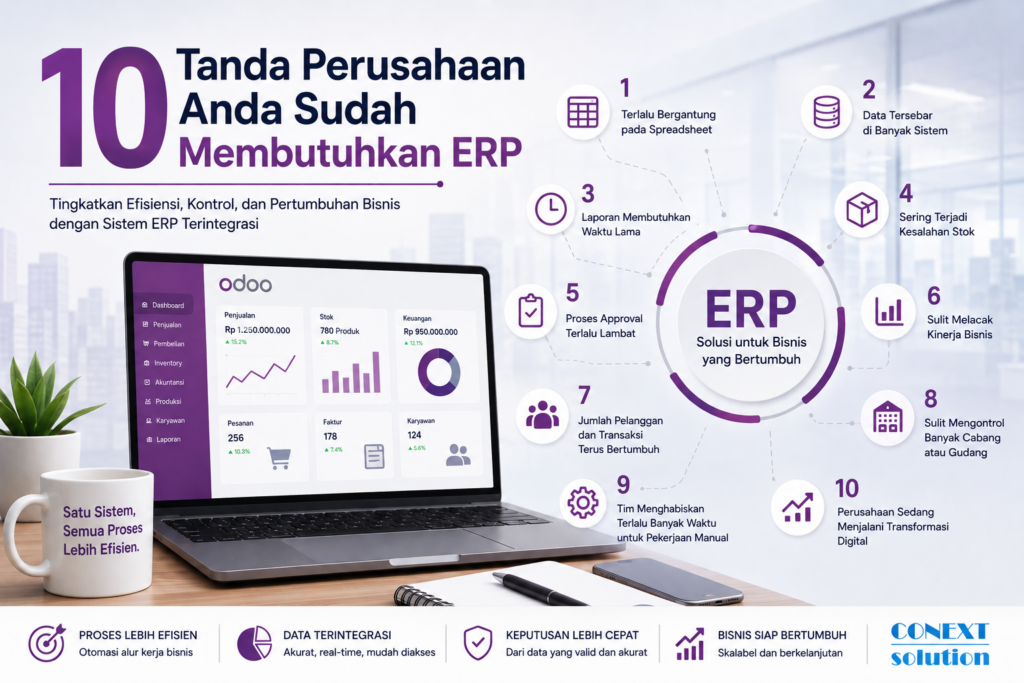
Here are 10 signs that indicate your company may already need an ERP system.
1. Over-Reliance on Spreadsheets
Spreadsheets are indeed flexible and easy to use.
However, as a business grows, overreliance on spreadsheets often leads to problems:
- Duplicate files
- Different versions of data
- Manual data entry errors
- Difficulty conducting audits
If most operations are still handled through Excel, this is a strong indication that the company needs a more integrated system.
2. Data Scattered Across Multiple Systems
Does the sales team use one application, the finance team use another, and the warehouse have its own system?
This situation often leads to:
- Data duplication
- Out-of-sync information
- Difficulty creating consolidated reports
An ERP system helps consolidate all company data into a single database.
READ ALSO: Odoo vs. SAP: Which Is a Better Fit for Indonesian Companies?
3. Reports Take a Long Time to Generate
Many companies need several days or even weeks just to generate monthly reports.
This is usually because:
- Data must be collected from multiple sources
- Recapitulation is done manually
- The validation process is time-consuming
An ERP system can generate reports in real time, allowing management to make decisions faster.
4. Frequent Inventory Errors
Inventory issues are one of the most common reasons companies adopt ERP.
Common symptoms include:
- Physical inventory differs from the system
- Missing items
- Overstock
- Stockouts
ERP helps track inventory movements more accurately.
5. The Approval Process Is Too Slow
As a company grows, the approval process becomes increasingly complex.
Example:
- Purchase Approval
- Payment approval
- Leave approval
- Budget approval
If these processes are still handled via email or chat, an ERP system can help automate the approval workflow.
6. Difficulty Tracking Business Performance
Management needs data to make decisions.
However, if information is hard to come by, decisions are often made based on assumptions.
An ERP system provides dashboards that allow management to monitor:
- Sales
- Cash flow
- Inventory
- Production
- Team performance
in real time.
7. The Number of Customers and Transactions Continues to Grow
Business growth is a positive thing.
However, growth also brings new challenges.
More customers and transactions mean:
- More data
- More processes
- A higher risk of errors
ERP helps companies remain efficient even as transaction volumes increase.
8. Difficulty Managing Multiple Branches or Warehouses
Companies that have:
- Many branches
- Many warehouses
- Operations in various locations
often have difficulty monitoring activities comprehensively.
ERP allows all locations to be connected within a single system.
9. Teams Spend Too Much Time on Manual Tasks
Many administrative tasks can actually be automated.
For example:
- Invoice generation
- Data reconciliation
- Inventory management
- Report generation
If employees spend most of their time on administrative tasks, an ERP system can significantly boost productivity.
10. The Company Is Undergoing a Digital Transformation
Digital transformation isn’t just about buying new software.
Digital transformation means building business processes that are more integrated, efficient, and data-driven.
ERP often serves as the cornerstone of a company’s digital transformation journey.
What Are the Risks of Delaying ERP Implementation?
Many companies delay ERP implementation because they consider the investment costs too high.
However, the costs resulting from inefficient processes are often far higher.
Potential risks include:
- Missed business opportunities
- Operational errors
- Low productivity
- Increased operating costs
- Difficulty scaling the business
How to Get Started with ERP Implementation?
If your company is experiencing some of the signs listed above, the first step is to evaluate your business processes.
Here are some things to prepare:
- Identify the main issues
- Define the implementation goals
- Select the appropriate ERP
- Assemble an internal team
- Collaborate with an experienced implementation partner
SEE ALSO: How Much Does Odoo ERP Implementation Cost in Indonesia? A Complete Guide for 2026
ERP isn’t just for large companies.
Today, many small and medium-sized companies use ERP to improve efficiency and support business growth.
If your company is starting to experience issues such as unsynchronized data, inventory errors, slow reports, or excessive manual processes, then it may be time to consider implementing an ERP system.
With the right ERP system, companies can operate more efficiently, make decisions faster, and build a strong foundation for long-term growth.