Financial management is one of the most important aspects of running a business. Errors in recording transactions, delays in financial reporting, and time-consuming reconciliation processes can hinder a company’s growth.
Many companies still rely on a combination of spreadsheets and accounting software that are separate from their other operational systems. As a result, data is often out of sync and requires repetitive manual work.
To address these issues, many companies are beginning to switch to ERP systems with integrated accounting modules, such as Odoo Accounting.
This module helps companies manage all financial processes on a single platform connected to sales, purchasing, inventory, and other business operations.
What Is Odoo Accounting?
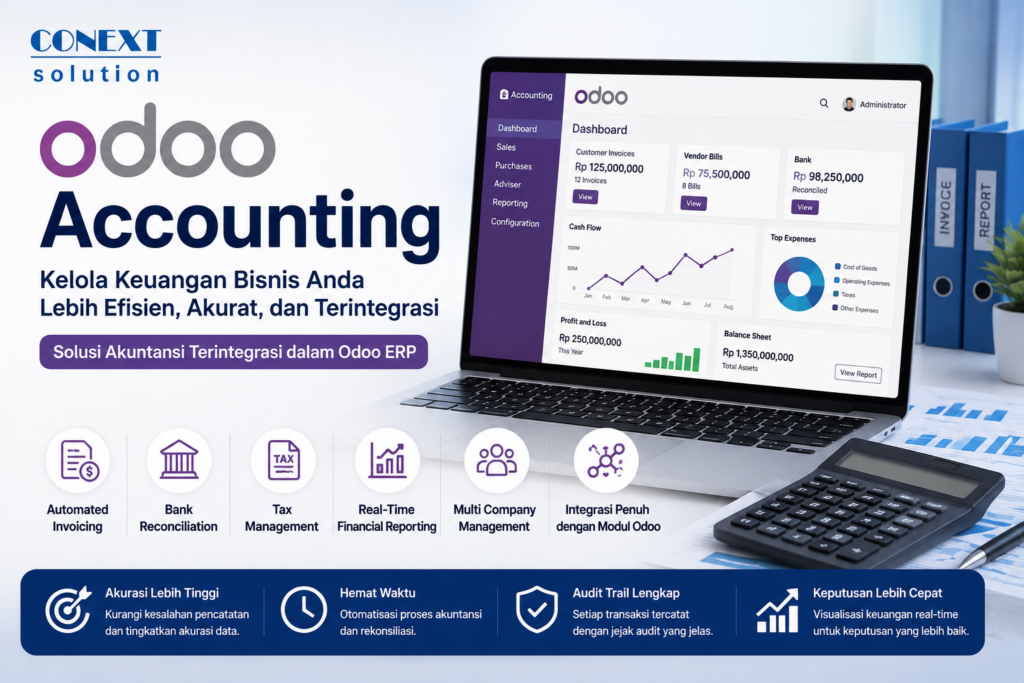
Odoo Accounting is an accounting module that is part of the Odoo ERP ecosystem.
This module is designed to help companies manage:
- Bookkeeping
- Customer invoices
- Vendor invoices
- Bank reconciliations
- Taxes
- Financial reports
All financial data is automatically integrated with other business activities, reducing manual work and improving data accuracy.
Key Features of Odoo Accounting
1. Automated Invoicing
Invoices can be generated automatically based on sales transactions.
Benefits:
- Reduces manual data entry
- Speeds up the billing process
- Reduces the risk of errors
SEE ALSO: Excel vs. ERP: Why Are Spreadsheets No Longer Enough for Growing Businesses?
2. Bank Reconciliation
Odoo helps automatically match bank transactions with accounting records.
Benefits:
- Faster reconciliation
- Reduces recording errors
- Simplifies audits
3. Real-Time Financial Reporting
Financial reports can be accessed at any time without having to wait for manual reconciliation.
Available reports include:
- Profit & Loss
- Balance Sheet
- Cash Flow
- General Ledger
4. Multi-Company Management
Companies with multiple business entities can manage all financial activities within a single system.
5. Tax Management
Odoo Accounting helps companies manage various applicable tax regulations.
This feature facilitates more accurate tax calculations and reporting.
6. Accounts Payable and Accounts Receivable
Companies can monitor:
- Customer receivables
- Vendor payables
- Payment due dates
- Company cash flow
in real time.
Benefits of Odoo Accounting for Companies
Improved Financial Accuracy
Since data comes directly from business transactions, the risk of input errors can be significantly reduced.
Saves Time
Many processes that were previously done manually can be automated.
Simplifying Audits
Every transaction has a clear audit trail, making it easier to trace.
Supports Decision-Making
Management can view the company’s financial status in real time.
Cross-Departmental Integration
Sales, purchasing, inventory, and accounting data are all in the same system.
Odoo Accounting vs. Standalone Accounting Software
| Features | Standalone Accounting Software | Odoo Accounting |
|---|---|---|
| ERP Integration | Limited | Yes |
| Automated Invoicing | Partially | Yes |
| Inventory Integration | Limited | Yes |
| Sales Integration | Limited | Yes |
| Real-Time Reporting | Yes | Yes |
| Multi-Company | Depends on the System | Yes |
| Audit Trail | Yes | Yes |
SEE ALSO: Excel vs. ERP: Why Are Spreadsheets No Longer Enough for Growing Businesses?
Who Should Use Odoo Accounting?
Distributors
Manage high-volume sales and purchasing transactions.
Manufacturing
Linking production costs to financial reports.
Retail
Integrating POS transactions with accounting.
Service Companies
Monitoring cash flow and project profitability more accurately.
Integration with Other Odoo Modules
One of the key advantages of Odoo Accounting is its integration with:
- Odoo Sales
- Odoo Purchasing
- Odoo Inventory
- Odoo Manufacturing
- Odoo CRM
With this integration, all business activities are automatically reflected in financial reports without the need for re-entry.
Challenges of Implementing Odoo Accounting
Although it offers many benefits, implementing Odoo Accounting still requires careful planning.
Here are some things to keep in mind:
- Financial data migration
- Chart of Accounts Mapping
- Tax configuration
- User training
- Business process integration
That’s why many companies choose to partner with experienced Odoo implementation consultants.
Odoo Accounting is a modern accounting solution that integrates with all of a company’s business processes.
With features such as automated invoicing, bank reconciliation, tax management, and real-time financial reporting, companies can improve operational efficiency while gaining better financial visibility.
For companies undergoing digital transformation, Odoo Accounting can serve as a crucial foundation for building a more accurate, efficient, and scalable financial system.
FAQ
What is Odoo Accounting?
Odoo Accounting is an accounting module within Odoo ERP that helps companies manage their bookkeeping, invoices, taxes, and financial reports in an integrated manner.
Is Odoo Accounting suitable for companies in Indonesia?
Yes. Odoo Accounting can be configured to meet the needs of companies in Indonesia, including tax management and financial reporting.
What are the advantages of Odoo Accounting compared to standard accounting software?
Its main advantage is direct integration with the sales, purchasing, inventory, manufacturing, and CRM modules within a single ERP system.
Does Odoo Accounting support multiple companies?
Yes. Odoo Accounting allows companies to manage multiple business entities on a single platform.
Can Odoo Accounting perform bank reconciliation?
Yes. Odoo Accounting has a bank reconciliation feature that automatically matches bank transactions with accounting records.
Is Odoo Accounting suitable for SMEs?
Yes. Odoo Accounting can be used by both SMEs and large companies due to its flexible scalability.