In an increasingly competitive business world, retaining customers is just as important as acquiring new ones. Many companies still manage prospect data, sales activities, and customer communications using spreadsheets or separate applications. This approach often leads to data discrepancies, delayed follow-ups, and even missed sales opportunities.
This is where Odoo CRM comes in as a solution that helps companies manage the entire sales process within a single, integrated system. With automation features, activity tracking, and easy-to-understand dashboards, Odoo CRM helps sales teams work more effectively while enhancing the customer experience.
What Is Odoo CRM?
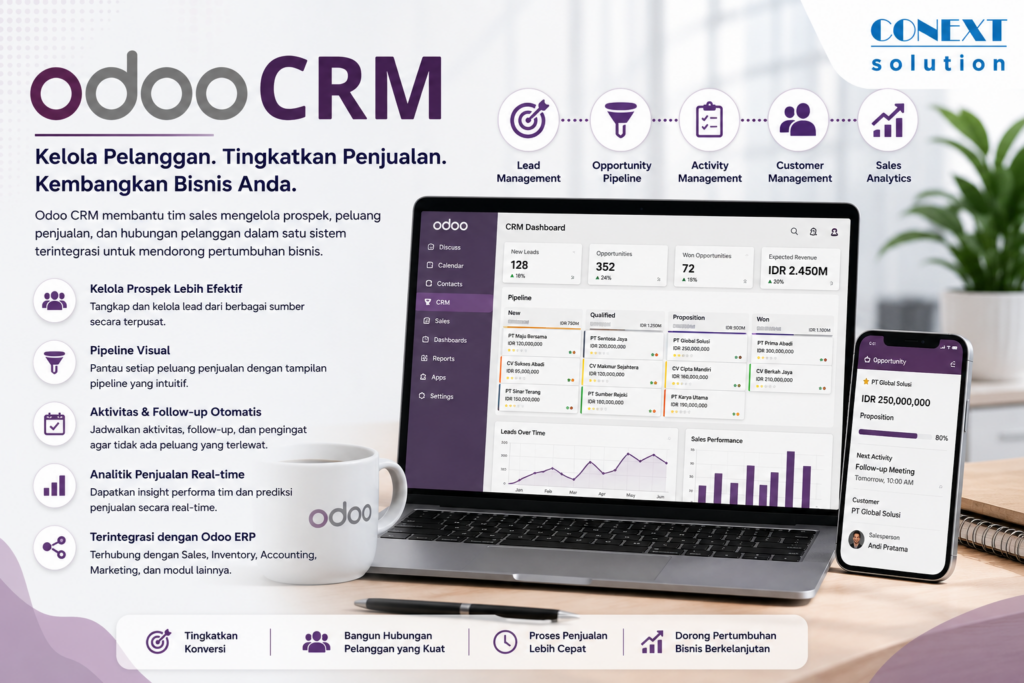
Odoo CRM is a Customer Relationship Management module that is part of the Odoo ERP ecosystem. This module is designed to help companies manage leads, sales opportunities, sales activities, and even analyze sales team performance.
Because it’s integrated with other modules such as Sales, Inventory, Accounting, Marketing Automation, and Helpdesk, all customer information can be accessed from a single platform without having to switch between applications.
Why Do Companies Need CRM?
Many companies experience growth in their customer base, but this isn’t accompanied by an effective management system. As a result, sales teams struggle to track the status of leads, communication history, and follow-up schedules.
CRM helps companies to:
- Manage the customer database centrally.
- Track all sales activities.
- Ensure every prospect receives a follow-up.
- Improve collaboration among sales team members.
- Provide real-time sales reports.
With a structured system, companies can increase conversion opportunities and build long-term relationships with customers.
Key Features of Odoo CRM
1. Lead Management
All incoming leads can be automatically recorded, whether from the website, email, forms, or other marketing activities. Each lead can be assigned a status, priority, and a responsible person so that no opportunity is missed.
2. Opportunity Management
Once a lead meets specific criteria, it can be converted into an opportunity. The sales team can monitor every stage of the sales process through an intuitive pipeline view.
3. Sales Pipeline
The visual pipeline allows companies to see the status of every sales opportunity, from new leads to closed deals. The drag-and-drop interface makes it easy for teams to update statuses without a complicated process.
4. Activity Management
Odoo CRM provides automatic reminders for phone calls, emails, meetings, and follow-ups so that every sales activity stays on schedule.
5. Dashboards and Reporting
Management can view sales reports, opportunity values, sales performance, conversion rates, and revenue forecasts all in one interactive dashboard.
Benefits of Odoo CRM for Companies
Increases Sales Team Productivity
The sales team no longer spends a lot of time on administrative tasks. Customer information is automatically stored, allowing them to focus more on sales activities.
Increasing Conversion Rates
With a more structured follow-up process, sales opportunities can be processed faster, and the likelihood of successful transactions increases.
Better-Organized Customer Data
All communication history, quotes, meeting schedules, and customer documents are stored in a single system.
Easier Cross-Team Collaboration
The marketing, sales, and customer service teams can access the same customer information, making coordination more effective.
More Accurate Sales Analysis
Real-time dashboards help management evaluate sales performance and make data-driven decisions.
Odoo CRM Integration with Other Modules
One of the advantages of Odoo CRM is its integration with various other modules in Odoo ERP.
For example:
- A lead that becomes a customer → is automatically forwarded to the Sales module.
- Sales Order → linked to Inventory.
- Invoice → created through Accounting.
- Marketing activities → managed through Marketing Automation.
- Customer complaints → are forwarded to the Helpdesk.
This integration reduces manual work and improves operational efficiency.
Who Should Use Odoo CRM?
Odoo CRM is suitable for various types of companies, such as:
- Distributors.
- Manufacturing companies.
- Retailers.
- Professional services.
- Technology companies.
- Growing startups.
Because it’s modular, companies can start with CRM and then add other modules as needed.
Odoo CRM vs. Manual Customer Management
| Aspect | Manual | Odoo CRM |
|---|---|---|
| Customer Data | Scattered | Centralized |
| Follow-up | Manual | Automated |
| Sales Pipeline | Unstructured | Visual |
| Reports | Slow | Real-time |
| ERP Integration | None | Integrated |
SEE ALSO: SAP Business One vs. Odoo: Which ERP Is Better for Your Business?
Tips for a Successful Odoo CRM Implementation
To ensure a successful implementation, companies need to:
- Define clear sales processes.
- Clean up customer data before migration.
- Train the sales team to use the system.
- Customize the pipeline to align with business processes.
- Integrate the CRM with other ERP modules.
This approach will help companies get the most out of Odoo CRM.
Odoo CRM is a Customer Relationship Management solution that helps companies manage leads, customers, and sales activities in a more structured way. With features such as lead management, a visual pipeline, real-time dashboards, and full integration with Odoo ERP, companies can boost their sales team’s productivity while delivering a better customer experience.
For companies undergoing digital transformation, implementing Odoo CRM is a strategic step toward improving operational efficiency, strengthening customer relationships, and driving sustainable business growth.
SEE ALSO: ODOO ERP IMPLEMENTATION: PHASES, BENEFITS, AND SUCCESS FACTORS
FAQ
What is Odoo CRM?
Odoo CRM is the Customer Relationship Management module within the Odoo ERP implementation, used to manage leads, customers, sales activities, and the sales pipeline in an integrated manner.
What are the benefits of Odoo CRM?
Odoo CRM helps increase sales team productivity, speed up follow-up processes, centrally manage customer data, and provide real-time sales reports.
Can Odoo CRM be integrated with other modules?
Yes. Odoo CRM integrates with the Sales, Inventory, Accounting, Marketing Automation, and Helpdesk modules.
Is Odoo CRM suitable for SMEs?
Yes. Odoo CRM can be used by small, medium, and large businesses because it is modular and easily scalable.
Why do companies need CRM?
CRM helps companies manage customer relationships more effectively, increase sales opportunities, and provide better service.